
CONDITIONS WE TREAT · امراض
کھیل کی چوٹ
A sprained ankle, a pulled hamstring, a knee that gives way, a shoulder strained in a throw — sports injuries are not just bad luck. They happen where load exceeds what the structure was ready for. Our work is to restore the injured tissue, correct the imbalance that let it happen, and return you to play with the structure stronger than before. Sports injury treatment Rawalpindi, done properly, is all three at once — tissue, imbalance and graded return — not just rest and ice.
Book an Assessment → All Conditions →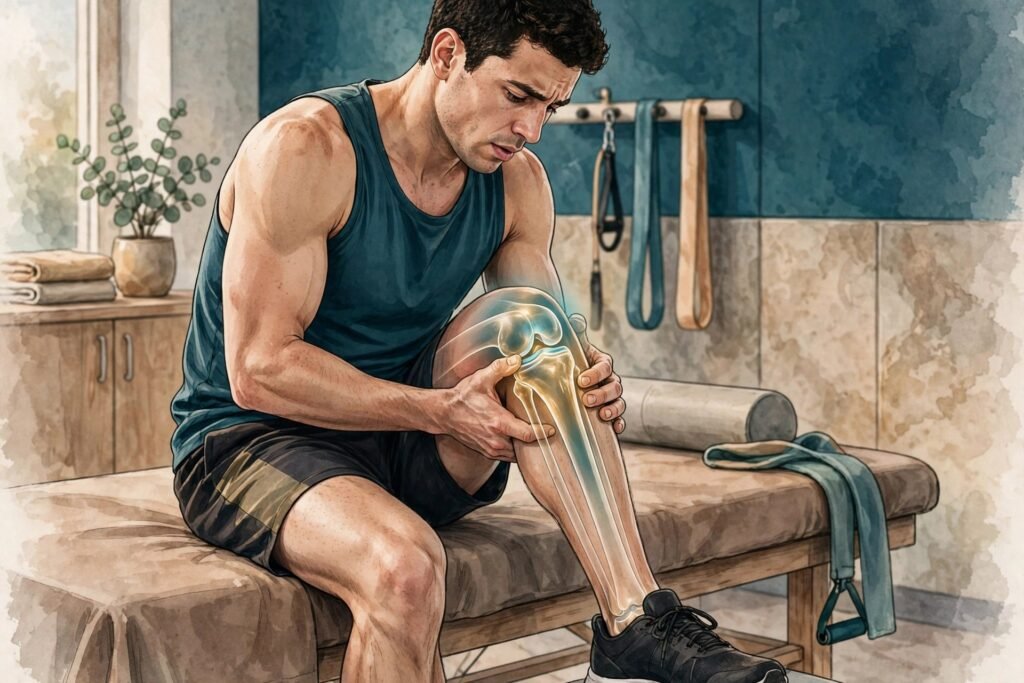
A strain is a muscle or tendon overstretched; a sprain is a ligament overstretched, usually at the ankle or knee. Around the injury, muscles guard, the joint stiffens, and the body's movement pattern changes to protect the sore spot — which then loads other joints unevenly. Treating only the sore spot leaves the pattern in place, and the injury returns. The NHS guidance on sports injuries covers the early care — rest, ice, compression — and when an injury needs professional assessment rather than self-care.
Pain at the injured spot, swelling and bruising in the first days, stiffness and weakness, pain on the movement that caused it, and a joint that feels unstable or unreliable under load.
The injury hurts on a specific movement — landing, cutting, throwing — and eases at rest.
The joint swells after use and stiffens overnight, then loosens as the day goes on.
The joint feels as if it might give way, or the muscle cannot produce its normal strength.
Sudden overload, poor landing or cutting mechanics, muscle imbalance between sides, a stiff ankle or hip that forces the knee to compensate, and returning to play before the tissue had recovered.
Weekend players who train hard without recovery, cricketers and footballers with repetitive throwing and cutting, and anyone who increased training load too fast.
In Tibb-e-Unani terms, recovery after injury is a matter of restoring the tissue's temperament: warming, circulation-supporting measures where the tissues have gone cold and stiff, and diet and herbal support that feed tissue repair. The manual work restores movement; the Unani tiers support the tissue doing the healing.
Every case at Al Mualij is assessed through ISRA™ — Integrated Structural Rehabilitation Architecture — nine connected stages: intake, lifestyle, Unani constitutional assessment, clinical exam, imaging, the SBRA™ analysis engine, classification into Types A–D, a four-phase roadmap, and follow-up intelligence. Nothing is treated before it is assessed.
The SBRA™ engine — Structural & Biological Rehabilitation Architecture — scores five structural pillars (Alignment, Mobility, Joint Function, Biomechanics, Posture) and five biological pillars (Recovery, Lifestyle, Traditional (Unani), Tissue Support, Nervous System), and returns your Structural Integrity Score™, Structural Age™, Recovery Capacity Score™ and Recovery Risk Score™. The scores decide what is corrected first — and what is left alone.
For sports injuries, the SBRA™ Tissue Support and Biomechanics pillars lead — they show which tissues are ready to load and which still need protection, so the return to play is graded rather than guessed.
Your treatment follows the four-phase ISRA roadmap — Assess, Correct, Support, Maintain — with manual adjustment at its centre and the Unani tiers supporting it. There are no pre-sold packages: the exact plan is set after your assessment and confirmed by the clinic before treatment begins.
Full first consultation — your history, Nabz and Mizaj, structural examination, and review of your MRI or X-ray. The SBRA™ scores from this visit shape the whole plan.
Hands-on structural correction — Ilaj-bil-Yad, manual adjustment of alignment, mobility and joint function — is the core of this phase. Dalak, therapeutic massage with warm medicated herbal oils, prepares stiff, guarded tissue before correction where it is needed.
The Unani tiers that fit your case support the correction from inside: Ilaj-bil-Dawa (herbal formulations matched to your Mizaj and condition), Ilaj-bil-Tadbeer including Hijama where assessment supports it, and Ilaj-bil-Ghiza (diet prescribed as medicine). For sports injuries, the Correct phase includes joint and soft-tissue work around the injury, and the Maintain phase is a graded return-to-play plan built on re-measured strength and movement.
Graded movement, daily-load coaching and a follow-up schedule, with progress re-measured at each visit and the plan adjusted as your structure changes.
Pain rarely stays in one place. These pages explain the conditions most often seen alongside this one.
Learn more about how we work: Our Method explains ISRA™ and SBRA™ in full, Treatments explains the four pillars of Unani care, and FAQs answers the questions patients ask before a first visit. Book an assessment at our Satellite Town clinic — sports injury treatment Rawalpindi starts with a full first consultation.
Our Method — ISRA & SBRA → Treatments — Four Pillars → FAQs → Book an Assessment on WhatsApp