
CONDITIONS WE TREAT · امراض
جوڑوں کا درد
A shoulder that will not lift, a knee that stiffens overnight, joints that ache with the weather changing. Joint pain is often treated as a problem inside the joint alone. At Al Mualij we treat the joint, the structure around it, and the biology that keeps it inflamed — because all three decide whether it moves again. That full picture is what frozen shoulder treatment Rawalpindi looks like at Al Mualij — assessment first, then hands-on work and warming Unani support together.
Book an Assessment → All Conditions →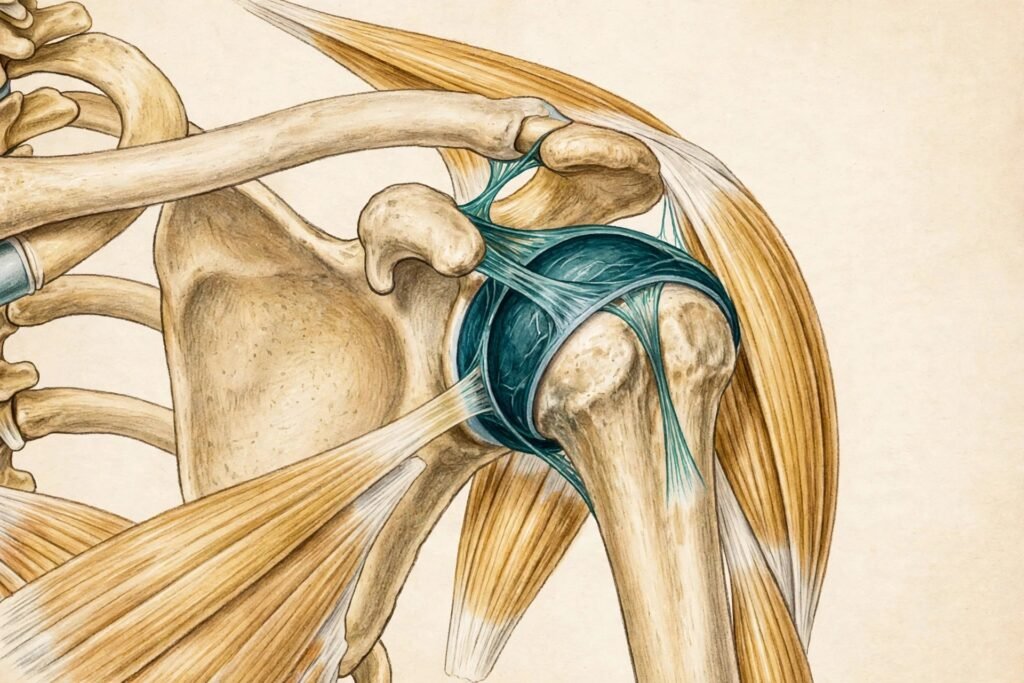
A frozen shoulder is a capsule — the sleeve around the shoulder joint — that has thickened and tightened until the arm cannot lift or rotate. It usually follows a period of not moving the arm, an injury, or a long-standing strain, and it is often seen alongside diabetes. Other joint pain follows the same logic at a smaller scale: cartilage wear, inflamed tissues, and muscles that no longer support the joint evenly. The NHS guidance on frozen shoulder describes how the capsule thickens and movement narrows — and why gentle, graded movement matters more than forcing the joint.
A deep ache in the shoulder that worsens at night, pain reaching for a shelf or behind the back, and a steady loss of movement — dressing and combing hair become difficult. Knee and other joint pain shows as stiffness after rest, aching on stairs, and swelling after use.
The arm will not lift overhead or reach behind the back — and the loss creeps in over weeks.
The shoulder aches most at night and when lying on that side, disturbing sleep.
Joints feel locked after sitting or sleeping, then loosen slowly with gentle movement.
Immobility after injury or surgery, repetitive overhead work, diabetes and thyroid disorders that thicken the capsule, and years of uneven load on knees and other weight-bearing joints.
The shoulder freezes because it was not moved; the knee wears because it was loaded unevenly. In both cases, avoiding movement feels safer — and makes the stiffness worse.
In Tibb-e-Unani terms, frozen joints carry a strong cold and dry tendency: the tissues contract, lubrication falls, and movement narrows. Warming measures lead the support here — warm medicated oils in Dalak, diet that suits the temperament, and herbal formulations traditionally used for joint stiffness and nerve support.
Every case at Al Mualij is assessed through ISRA™ — Integrated Structural Rehabilitation Architecture — nine connected stages: intake, lifestyle, Unani constitutional assessment, clinical exam, imaging, the SBRA™ analysis engine, classification into Types A–D, a four-phase roadmap, and follow-up intelligence. Nothing is treated before it is assessed.
The SBRA™ engine — Structural & Biological Rehabilitation Architecture — scores five structural pillars (Alignment, Mobility, Joint Function, Biomechanics, Posture) and five biological pillars (Recovery, Lifestyle, Traditional (Unani), Tissue Support, Nervous System), and returns your Structural Integrity Score™, Structural Age™, Recovery Capacity Score™ and Recovery Risk Score™. The scores decide what is corrected first — and what is left alone.
Classification follows the assessment: Type A (structural collapse), Type B (structural + neural), Type C (structural + biological) or Type D (complex recovery). Your type sets the order of treatment — what is corrected first, and how fast the plan moves.
Your treatment follows the four-phase ISRA roadmap — Assess, Correct, Support, Maintain — with manual adjustment at its centre and the Unani tiers supporting it. There are no pre-sold packages: the exact plan is set after your assessment and confirmed by the clinic before treatment begins.
Full first consultation — your history, Nabz and Mizaj, structural examination, and review of your MRI or X-ray. The SBRA™ scores from this visit shape the whole plan.
Hands-on structural correction — Ilaj-bil-Yad, manual adjustment of alignment, mobility and joint function — is the core of this phase. Dalak, therapeutic massage with warm medicated herbal oils, prepares stiff, guarded tissue before correction where it is needed.
The Unani tiers that fit your case support the correction from inside: Ilaj-bil-Dawa (herbal formulations matched to your Mizaj and condition), Ilaj-bil-Tadbeer including Hijama where assessment supports it, and Ilaj-bil-Ghiza (diet prescribed as medicine). For joints, the Correct phase works the joint and the spine together: a stiff shoulder often needs the neck and upper back corrected too, since they drive how the shoulder moves.
Graded movement, daily-load coaching and a follow-up schedule, with progress re-measured at each visit and the plan adjusted as your structure changes.
Pain rarely stays in one place. These pages explain the conditions most often seen alongside this one.
Learn more about how we work: Our Method explains ISRA™ and SBRA™ in full, Treatments explains the four pillars of Unani care, and FAQs answers the questions patients ask before a first visit. Book an assessment at our Satellite Town clinic — frozen shoulder treatment Rawalpindi starts with a full first consultation.
Our Method — ISRA & SBRA → Treatments — Four Pillars → FAQs → Book an Assessment on WhatsApp