
CONDITIONS WE TREAT · امراض
کمر درد
Back pain is the most common reason patients come to us — and the most misunderstood. It is rarely one damaged part. It is usually a spine that has been loaded unevenly for a long time, until one movement too many makes it speak. Our work is to find the uneven load, correct it, and rebuild the support around it. This is back pain treatment Rawalpindi — assessment first, then correction of the load pattern, not just the painful spot.
Book an Assessment → All Conditions →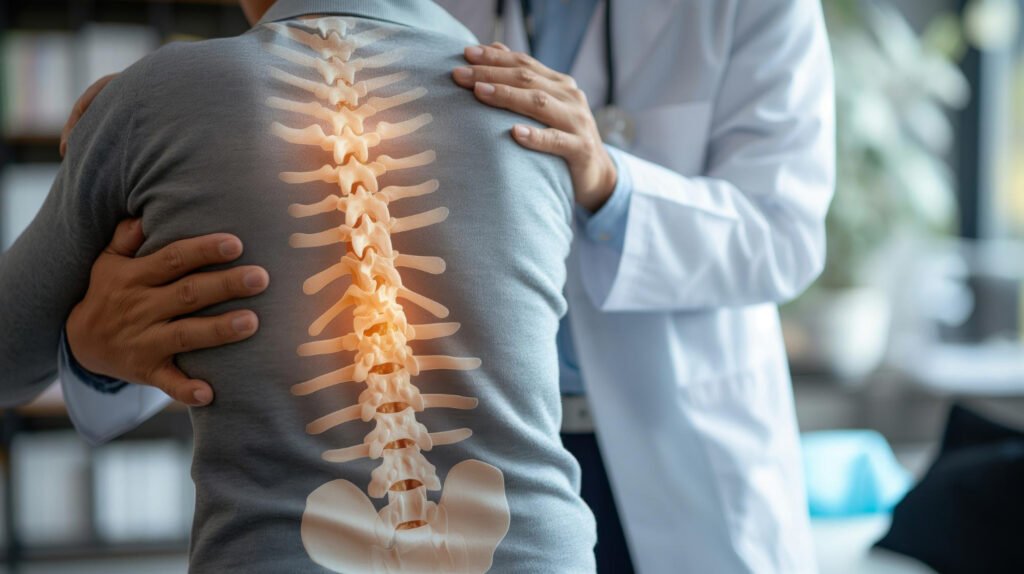
The lower back is a stack of vertebrae, discs, small facet joints and deep stabilising muscles. When the stack is aligned and the muscles share the load, it is strong. When alignment shifts, a joint locks, or the deep muscles switch off, the load concentrates — and the tissues around that spot become painful, inflamed and guarded. Most back pain we see is this mechanical story, not a single injury. The World Health Organization counts low back pain as the leading cause of disability worldwide — and most cases are mechanical, which is why the load pattern matters.
An ache across the lower back that worsens with sitting or bending, sharp pain on one movement, stiffness getting out of bed, pain that eases as you walk and returns when you sit. Some patients feel it spread into the buttock or thigh when a nerve is irritated.
Sitting, bending or lifting brings it on; walking or lying in a good position eases it.
The first half hour of the day is the hardest, then the back loosens as you move.
The muscles around the painful spot stay tight, as if protecting it — and the tightness itself becomes painful.
Long sitting, heavy or awkward lifting, weak deep core muscles, old injuries that healed in a compensated pattern, and disc wear that changes how the segments move. Weight and weak leg strength add load the back then has to carry.
Drivers, shopkeepers, office workers and housework all load the back in the same repeated way. The pain often appears after something small — bending to pick up a shoe — because the tolerance was already used up.
In Tibb-e-Unani terms, chronic back pain often sits with a cold and dry or cold and moist tendency: tissues stiffen or become heavy and sluggish, and recovery slows. Your Mizaj assessment guides the supporting measures — warming oils, diet, and herbal formulations that support the joints, nerves and tissue recovery.
Every case at Al Mualij is assessed through ISRA™ — Integrated Structural Rehabilitation Architecture — nine connected stages: intake, lifestyle, Unani constitutional assessment, clinical exam, imaging, the SBRA™ analysis engine, classification into Types A–D, a four-phase roadmap, and follow-up intelligence. Nothing is treated before it is assessed.
The SBRA™ engine — Structural & Biological Rehabilitation Architecture — scores five structural pillars (Alignment, Mobility, Joint Function, Biomechanics, Posture) and five biological pillars (Recovery, Lifestyle, Traditional (Unani), Tissue Support, Nervous System), and returns your Structural Integrity Score™, Structural Age™, Recovery Capacity Score™ and Recovery Risk Score™. The scores decide what is corrected first — and what is left alone.
Classification follows the assessment: Type A (structural collapse), Type B (structural + neural), Type C (structural + biological) or Type D (complex recovery). Your type sets the order of treatment — what is corrected first, and how fast the plan moves.
Your treatment follows the four-phase ISRA roadmap — Assess, Correct, Support, Maintain — with manual adjustment at its centre and the Unani tiers supporting it. There are no pre-sold packages: the exact plan is set after your assessment and confirmed by the clinic before treatment begins.
Full first consultation — your history, Nabz and Mizaj, structural examination, and review of your MRI or X-ray. The SBRA™ scores from this visit shape the whole plan.
Hands-on structural correction — Ilaj-bil-Yad, manual adjustment of alignment, mobility and joint function — is the core of this phase. Dalak, therapeutic massage with warm medicated herbal oils, prepares stiff, guarded tissue before correction where it is needed.
The Unani tiers that fit your case support the correction from inside: Ilaj-bil-Dawa (herbal formulations matched to your Mizaj and condition), Ilaj-bil-Tadbeer including Hijama where assessment supports it, and Ilaj-bil-Ghiza (diet prescribed as medicine). For the back, the Correct phase often includes spinal decompression work alongside adjustment, where assessment shows the discs need unloading.
Graded movement, daily-load coaching and a follow-up schedule, with progress re-measured at each visit and the plan adjusted as your structure changes.
Pain rarely stays in one place. These pages explain the conditions most often seen alongside this one.
Learn more about how we work: Our Method explains ISRA™ and SBRA™ in full, Treatments explains the four pillars of Unani care, and FAQs answers the questions patients ask before a first visit. Book an assessment at our Satellite Town clinic — back pain treatment Rawalpindi starts with a full first consultation.
Our Method — ISRA & SBRA → Treatments — Four Pillars → FAQs → Book an Assessment on WhatsApp