
CONDITIONS WE TREAT · امراض
وضع قطع
Rounded shoulders, a forward head, a hollow or flattened lower back — posture is not about looking straight. It is about how load travels through your spine all day. When it travels badly, joints wear, muscles tire, and pain becomes the daily background. Posture can be corrected — but only if the structure, the muscles and the daily habit are treated together. That is what posture correction Rawalpindi means here — all three treated together, over weeks, not a single adjustment.
Book an Assessment → All Conditions →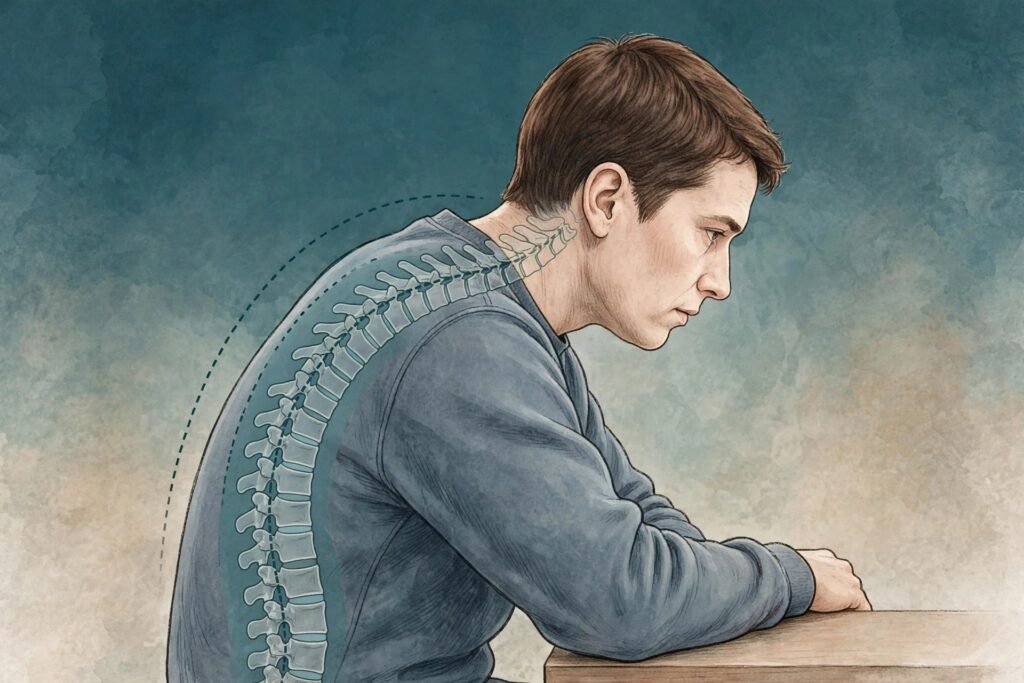
Good posture is a balanced stack: head over shoulders, shoulders over hips, the spine's natural curves sharing the load. Desk work, phones and long driving slowly pull the stack out of line — the head drifts forward, the upper back rounds (kyphosis), the shoulders roll in. Each centimetre of forward head adds load the neck and upper back must carry all day. The NHS guidance on posture lists the common mistakes — screen too low, phone held too far down — that slowly pull the stack out of line.
Aching between the shoulder blades by afternoon, a neck that feels heavy, tension headaches, shallow breathing from a compressed chest, and a back that tires quickly when standing. Many patients only notice the pattern when someone photographs them from the side.
The shoulders roll forward and the upper back curves, especially after hours at a desk.
The head sits in front of the shoulders, loading the neck and upper back all day.
Standing or walking for long tires the back quickly, because the muscles are working against the alignment.
Sustained sitting with a screen too low or too far, phone use with the head bent down, weak deep postural muscles, and a stiff mid-back that cannot extend. Once the pattern sets in, the body treats it as normal — which is why willpower alone rarely fixes it.
Students, office workers, drivers and anyone on a phone for hours are the usual patients. The load is small but constant, which is exactly why it does so much damage over years.
In Tibb-e-Unani terms, postural strain is a matter of structure and habit together: the body's temperament shapes which tissues stiffen and which weaken. Assessment of Mizaj, alongside the structural scores, decides where correction starts — the stiff segments first, or the weak support first.
Every case at Al Mualij is assessed through ISRA™ — Integrated Structural Rehabilitation Architecture — nine connected stages: intake, lifestyle, Unani constitutional assessment, clinical exam, imaging, the SBRA™ analysis engine, classification into Types A–D, a four-phase roadmap, and follow-up intelligence. Nothing is treated before it is assessed.
The SBRA™ engine — Structural & Biological Rehabilitation Architecture — scores five structural pillars (Alignment, Mobility, Joint Function, Biomechanics, Posture) and five biological pillars (Recovery, Lifestyle, Traditional (Unani), Tissue Support, Nervous System), and returns your Structural Integrity Score™, Structural Age™, Recovery Capacity Score™ and Recovery Risk Score™. The scores decide what is corrected first — and what is left alone.
For posture, the SBRA™ Posture and Biomechanics pillars usually lead the scores — they show exactly where the stack is out of line and which segments are carrying more than their share.
Your treatment follows the four-phase ISRA roadmap — Assess, Correct, Support, Maintain — with manual adjustment at its centre and the Unani tiers supporting it. There are no pre-sold packages: the exact plan is set after your assessment and confirmed by the clinic before treatment begins.
Full first consultation — your history, Nabz and Mizaj, structural examination, and review of your MRI or X-ray. The SBRA™ scores from this visit shape the whole plan.
Hands-on structural correction — Ilaj-bil-Yad, manual adjustment of alignment, mobility and joint function — is the core of this phase. Dalak, therapeutic massage with warm medicated herbal oils, prepares stiff, guarded tissue before correction where it is needed.
The Unani tiers that fit your case support the correction from inside: Ilaj-bil-Dawa (herbal formulations matched to your Mizaj and condition), Ilaj-bil-Tadbeer including Hijama where assessment supports it, and Ilaj-bil-Ghiza (diet prescribed as medicine). The Correct phase for posture is gradual: stiff segments are mobilised first, then alignment is corrected as the supporting muscles are retrained to hold it.
Graded movement, daily-load coaching and a follow-up schedule, with progress re-measured at each visit and the plan adjusted as your structure changes.
Pain rarely stays in one place. These pages explain the conditions most often seen alongside this one.
Learn more about how we work: Our Method explains ISRA™ and SBRA™ in full, Treatments explains the four pillars of Unani care, and FAQs answers the questions patients ask before a first visit. Book an assessment at our Satellite Town clinic — posture correction Rawalpindi starts with a full first consultation.
Our Method — ISRA & SBRA → Treatments — Four Pillars → FAQs → Book an Assessment on WhatsApp