
A man came to the clinic with pain down his leg. He had already been told, elsewhere, that it was sciatica and that he needed a course of treatment. He had not been examined. When we assessed him, the leg pain was not coming from a trapped nerve at all — it was coming from a muscle in the buttock pressing on the nerve, a lookalike we wrote about on Day 5. Same pain, different cause, different plan. If you are looking for spine assessment Rawalpindi, that story is the whole reason this article exists: treatment without assessment is a guess, and a guess with someone’s spine is not good enough.
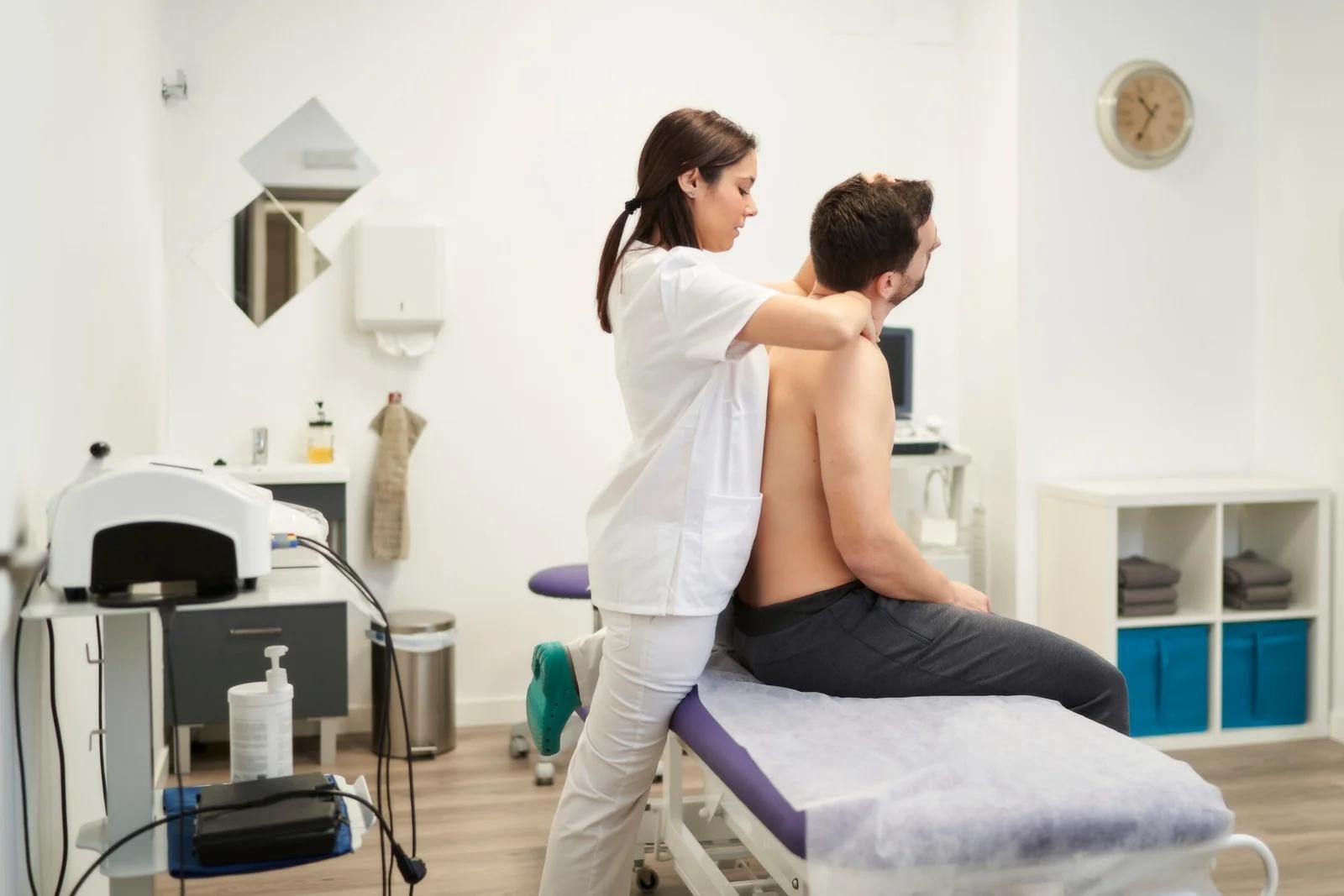
Two people, same pain, different problem
Back pain is a symptom, not a diagnosis. Two people can walk in with pain in the same place and need completely different care — a disc problem, a stiff joint, a nerve under pressure, or muscles overloaded by how they sit and lift. A scan alone does not tell you which one it is, and neither does a two-minute chat. What tells you is a proper assessment, done in order.
Spine assessment Rawalpindi: the nine stages, in plain words
At our clinic the assessment follows a system we call ISRA — Integrated Structural Rehabilitation Architecture. It has nine stages, and they run in the same order every time:
- Your story. When did it start, what makes it worse, what makes it better, what have you already tried. Your own account comes first, because pain has a history and the history matters.
- Your daily life. How you sit, stand, lift, sleep and work — the six everyday factors of Unani medicine, the Asbab-e-Sitta. A problem that only appears at work is a different problem from one that wakes you at night.
- Your Mizaj. Your constitution — whether you run warm or cold, dry or moist — and how that shapes your sleep, appetite, digestion and energy. As Day 20 explained, the same pain in two constitutions can need different care.
- The clinical examination. Posture, how you move, which joints move freely and which do not, where it hurts when you bend or twist, and what your muscles are doing.
- Imaging — only when it is needed. An X-ray or MRI is useful when the examination points to something that needs seeing, or when a red flag needs ruling out. It is not the starting point, and it is never the whole assessment.
- The SBRA analysis. SBRA — Structural & Biological Rehabilitation Architecture — is how we pull the findings together: five structural pillars (alignment, mobility, joint function, biomechanics, posture) and five biological ones (recovery, lifestyle, traditional Unani care, tissue support, the nervous system). It turns the findings into a picture of what is weak and what needs attention first.
- Classification. From that picture, your problem is placed in one of four types: A, a structural collapse; B, structural plus nerve involvement; C, structural plus biological factors; D, a complex recovery. The type decides what kind of plan makes sense.
- The four-phase roadmap. Assess, Correct, Support, Maintain. Every plan follows those four phases in that order, and hands-on correction — Ilaj Bil Yad — is part of the plan only when the assessment says it fits. No treatment without Tashkhees: no correction before a diagnosis.
- Follow-up. We check whether the plan is working and change it if it is not — the assessment is the baseline everything after it is measured against.
What the assessment actually decides
People sometimes ask why all of this is necessary for “just back pain.” It is necessary because the assessment decides three things that a guess cannot: what is safe to do, what is likely to help, and what would be a waste of your time and money. Hands-on correction helps a stiff joint. It does not help a problem that is mainly biological — poor sleep, weak recovery, a system run down. A disc problem and a muscle problem look alike from the outside and need different handling. Without the assessment, you can easily receive the right treatment for the wrong problem.
It also decides what not to do: some findings mean hands-on care should wait, or not happen at all — the assessment protecting you from care that does not fit.
When to come in the same day
Most back pain can wait for a booked assessment. Some signs cannot. Get checked the same day if you notice weakness in the leg that is getting worse, numbness in the saddle area, trouble controlling urine or stool, back pain with a fever, or severe pain after a fall or accident. Those are the same red flags we listed on Day 21, and they still apply: they are the signs that need ruling out before anything else.
A final word
Assessment is not a delay before the real work. It is the real work — everything after it is only as good as the understanding it is built on. That is why, at our clinic, spine assessment Rawalpindi means the full nine stages, in order, before any hands-on care: your story, your daily life, your Mizaj, the examination, imaging only when needed, the SBRA picture, the classification, the roadmap, and the follow-up. No shortcuts, no guessing, no treatment without Tashkhees.
Al Mualij — spine and sciatica treatments clinic, F-670, New Katariyan, F-Block, Satellite Town, Rawalpindi. Open every day, 10:00 AM–9:00 PM, including Friday. WhatsApp booking: +92 333 5166160.