
Most people who come to us have heard of Unani medicine, but few have had it explained as a system. They know it involves herbs. Some know it involves diet. Almost nobody knows it has four distinct parts, each with its own job — and that the herbs are only one of them.
Tibb-e-Unani is a complete system of medicine, built over centuries on a simple idea: health is balance, and treatment is restoring it. When something goes wrong — a back that keeps flaring, a knee that stiffens, digestion that never settles — the Unani physician looks at the whole picture first. Your temperament, what Unani calls Mizaj, is your body’s natural constitution: how you tend to run hot or cold, dry or moist, and how your tissues respond to food, weather and strain. Around that sit the six essential causes of health, Asbab-e-Sitta — air, food and drink, movement and rest, sleep and waking, retention and evacuation, and your mental state. These are the levers daily life pulls every day.
If you are looking for Unani treatment Rawalpindi care that starts with understanding your constitution before prescribing anything, this is how the four parts fit together.
1. Ilaj-bil-Ghiza — treatment through food
Food is the first medicine in Unani, and the gentlest. Ilaj-bil-Ghiza means adjusting what you eat — and how, and when — to suit your temperament and your condition.
A person with a cold, damp temperament who feels worse in winter may be advised toward warming foods and away from cold, heavy meals that add to the dampness. Someone whose digestion is sluggish may be asked to eat smaller meals, chew slowly, and leave long gaps between meals rather than grazing all day. None of this is a diet chart handed out to everyone. It is matched to the person, and it is usually the first step, because food is something you take every day — get it right and it works quietly in the background, get it wrong and it works against everything else.
2. Ilaj-bil-Tadbeer — treatment through regimen
Tadbeer is the daily routine: the habits and measures that shape the body over time. In Unani, regimen is not an afterthought — it is a treatment in its own right.
It covers the ordinary things: how much you move and how much you rest, how you sleep, how you bathe, and the hands-on measures that have been part of this medicine for centuries — cupping, massage, steam, and the careful use of heat and cold. A person whose back stiffens every morning might be guided on sleep position and morning movement; someone who sits all day might be shown how to break up the sitting before it becomes pain. The point is practical: small, repeated measures, done correctly, change the terrain the pain lives in.
3. Ilaj-bil-Yad — treatment by the hand
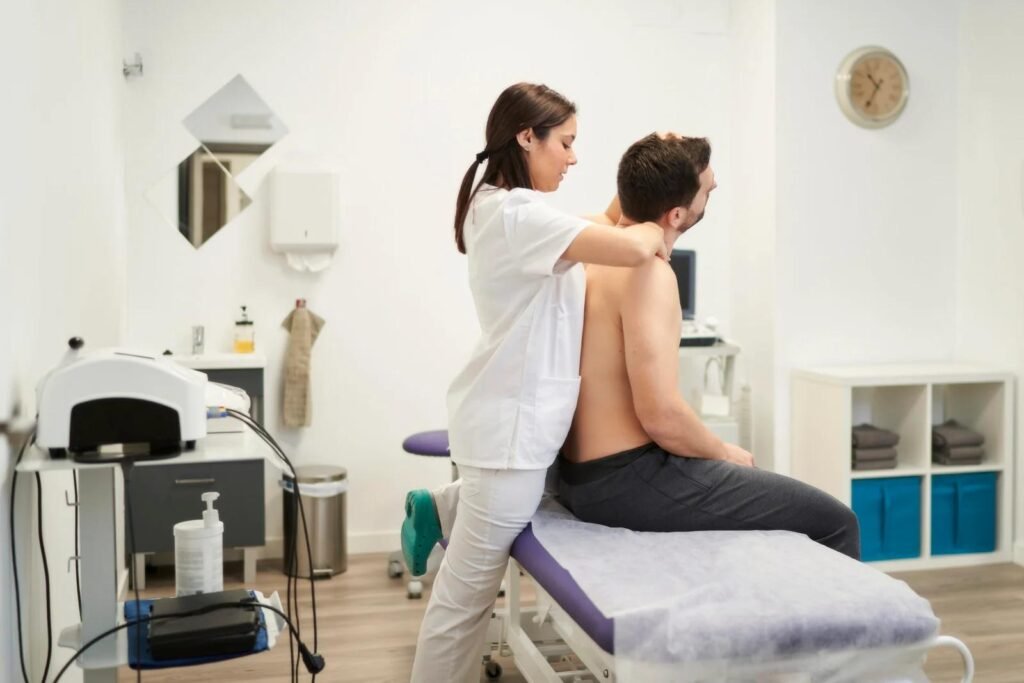
Ilaj-bil-Yad is hands-on structural care: assessment-led correction of alignment, movement and joint function, done by the physician’s hands. This is the part of Unani care our clinic is best known for, and it is also the part most often misunderstood.
It is never a first step for everyone. It comes only after assessment — the story, the examination, and where needed the imaging — shows that a structural correction fits this person and this problem. Massage of the muscles and joints, known as Dalak, sits inside this part, not as a separate pillar. When the assessment does not support hands-on correction, it is not done, and the plan leans on the other three parts instead. That discipline — treatment only where the assessment points — is what separates careful Unani practice from routine manipulation.
4. Ilaj-bil-Dawa — treatment through medicine
Dawa is the herbal medicine itself: single herbs and compound formulations, chosen for the person’s temperament and condition. This is the part most people associate with Unani, and it is powerful — but in the classical system it is the last of the four, not the first.
Medicine is prescribed after the food, the regimen and, where it fits, the hands-on care are already in place. It supports recovery: easing inflammation, supporting tissue, settling digestion, calming the nervous system. It is not a substitute for the other three parts, and a good Unani physician will tell you so plainly. Herbal medicine works best as part of a plan, and its dose and duration are set for the individual, not copied from a bottle.
How the four parts work as one plan
Here is the part that matters most: the four parts are not four separate treatments you pick from. They are one plan, ordered by the assessment.
A patient with a winter back flare might start with food and regimen — warming foods, better sleep position, gentle morning movement — add hands-on care if the assessment shows a structural problem, and take herbal medicine to support the recovery. Another patient, with a different temperament and a different cause, might need a different order entirely. That is why two people with the same complaint can leave with different plans, and why a treatment that helped your neighbour may not be the one for you.
If you have been taking herbal medicine without any change in food or habits, or having hands-on treatment without anyone asking about your temperament, you have been getting one part of the system, not the whole of it. The whole of it is what Unani treatment is meant to be.
Al Mualij — Spine and sciatica treatments clinic, F-670, New Katariyan, F-Block, Satellite Town, Rawalpindi. Open daily, 10:00 AM–9:00 PM, including Friday. Booking on WhatsApp: +92 333 5166160.
One Response